
Official website of
Evan Micheal Foster
Founder of IVA · Public administration researcher · Writer
I built IVA to help organizations govern consequential choices across evidence, authority, money, operations, capacity, learning, external obligations, implementation, and review. Rule 52 applies the same discipline to workplace AI use.

Where to start
Three places to find my work.
If you need help with a real decision, start with IVA. If you want the research behind the work, use the research portal. This site holds my background, writing, publications, and public record.
IVA Decision Architecture
A proprietary Five-Ledger Model for governing evidence, authority, resources, tradeoffs, commitments, implementation, and review.
Open the Decision Architecture track ↗ResearchRead the technical work
The research portal documents the models, evidence, working papers, claim limits, and public records behind IVA.
Open the research portal ↗WritingSee how the problems affect people
Essays about overload, financial dominance, unclear authority, duplicate reporting, hidden cleanup, and what AI changes.
Read the essays →Applied work
Two tracks. Four levels.
Choose IVA Decision Architecture for complex organizational decisions or Rule 52 for workplace AI. Then choose Start, Triage, Sprint, or Sustain.
IVA Decision Architecture
Use this when evidence, authority, capacity, funding, tradeoffs, and accountability do not line up across the organization.
Open the track ↗Track 2Rule 52 AI Use Readiness
Use this when AI access, action authority, human review, evidence, exceptions, incidents, and stop conditions are not governed together.
Open the track ↗Buying pathStart, Triage, Sprint, or Sustain
Begin with a $200 call, use $500 triage for a bounded assessment, build the architecture through Sprint, or maintain accountability through Sustain.
Compare levels and fees ↗Selected research
Working papers
The research portal holds the full records, persistent DOI links, SSRN records, and evidence boundaries.
Beyond Financial Dominance
A multi-ledger architecture that gives financial, operational, capacity, learning, and external value independent standing.
Internal Governance Monopoly
A working concept for structural failure when one internal domain gains disproportionate authority over value, evidence, resources, and legitimate action.
Visual models
Three diagrams for people who want the technical model.
Each record includes the high-resolution image, vector PDF, caption, alt text, citation, DOI, and source explanation.
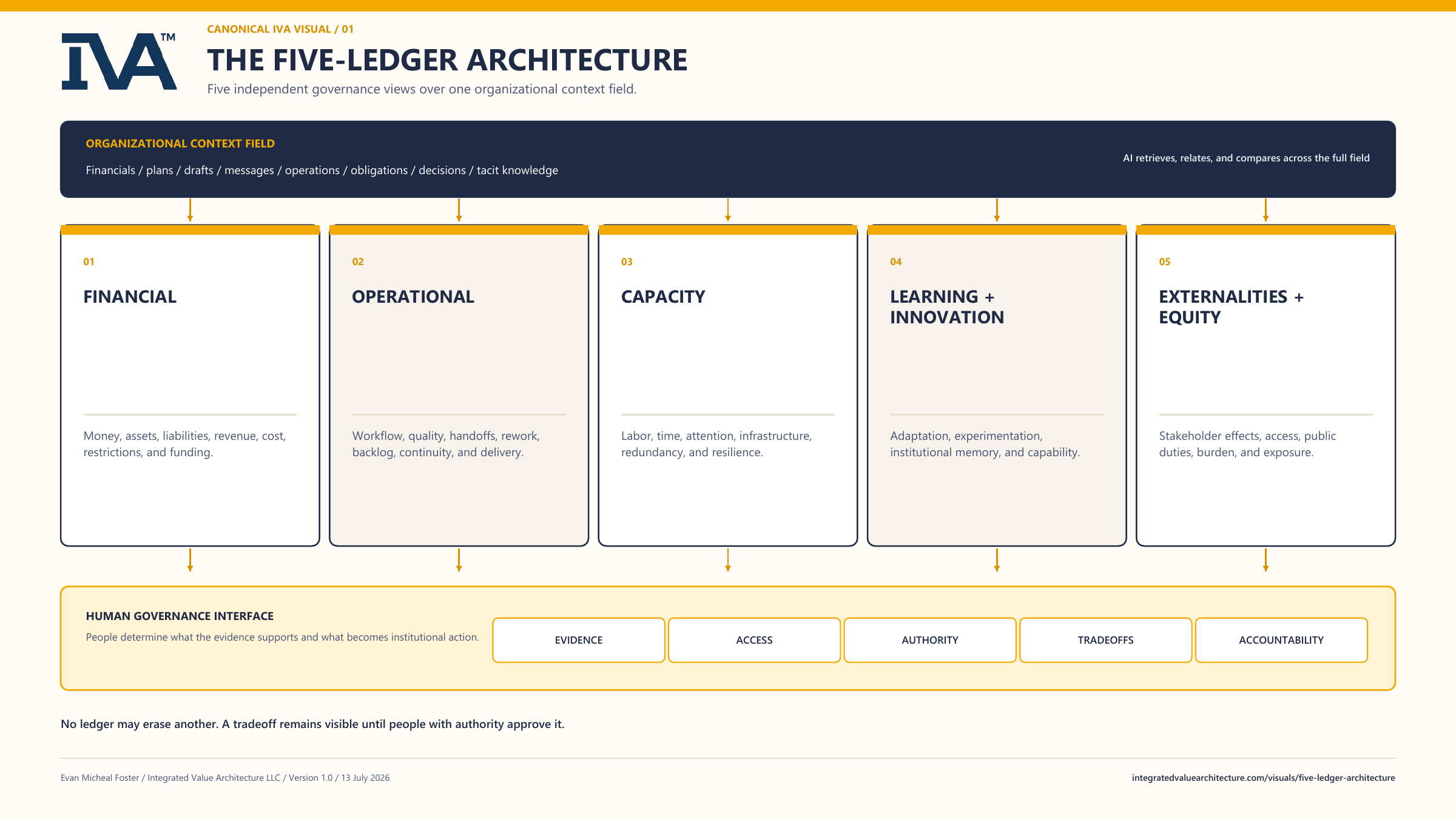
The Five-Ledger Architecture
Five independent governance views over one organizational context field.
DOI 10.5281/zenodo.21340449Open the full record ↗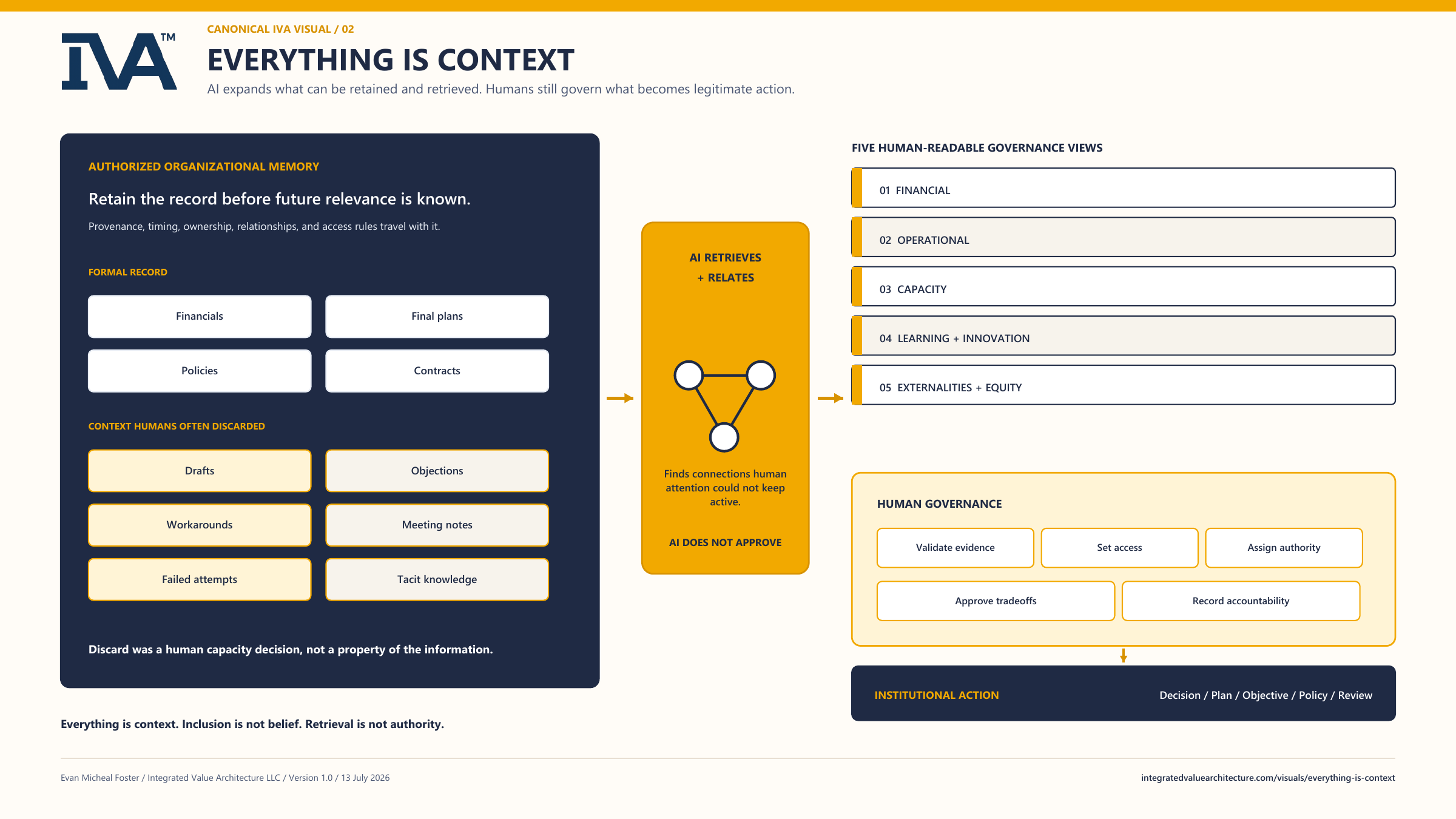
Everything Is Context
AI expands retention and retrieval. People govern what becomes legitimate action.
DOI 10.5281/zenodo.21340455Open the full record ↗
SMART versus Value-Based Objectives™
Target-writing criteria compared with IVA's whole-system performance test.
DOI 10.5281/zenodo.21340459Open the full record ↗Current writing
Plain language about how organizations actually work.
If an idea cannot be explained plainly enough to use, it is not finished.
Everything is context
Evan Micheal Foster explains why context-aware AI changes what organizations can afford to classify as useless information.
Read essay →Capacity and organizational designOverload is structural, not a personal failure
Why productivity advice fails when organizations assign responsibility without authority, evidence, or real capacity.
Read essay →Financialization and organizational authorityWhen finance stops measuring and starts governing
How financial information can become the default authority over operational, capacity, learning, and external value.
Read essay →Decision rights and accountabilityResponsibility without authority is a structural trap
Why accountability fails when the person carrying the result cannot change the evidence, resources, approvals, or tradeoffs shaping it.
Read essay →A career across institutions
I did not arrive at this work from one sector.
My work has included automotive finance, emergency-department documentation, laboratory operations, public health, local regulation, national nonprofit programs, board finance, and doctoral research.
Across those roles, I kept seeing the same problem: people were held responsible for decisions while authority, evidence, time, and money sat somewhere else. IVA was built from that operating pressure, not from slideware.
Professional background“People should not have to absorb duplicate reporting, unassigned cleanup, and approvals they have no authority to change.
Public record
Go straight to the page you need.
These pages use the same name, Litchfield location, IVA affiliation, publication identifiers, and public contact details.
Research · Media · Speaking · Applied work
If the operating problem matters, start with the problem, owner, deadline, and existing records.
You do not need a polished memo. IVA will identify the right track and smallest justified level.